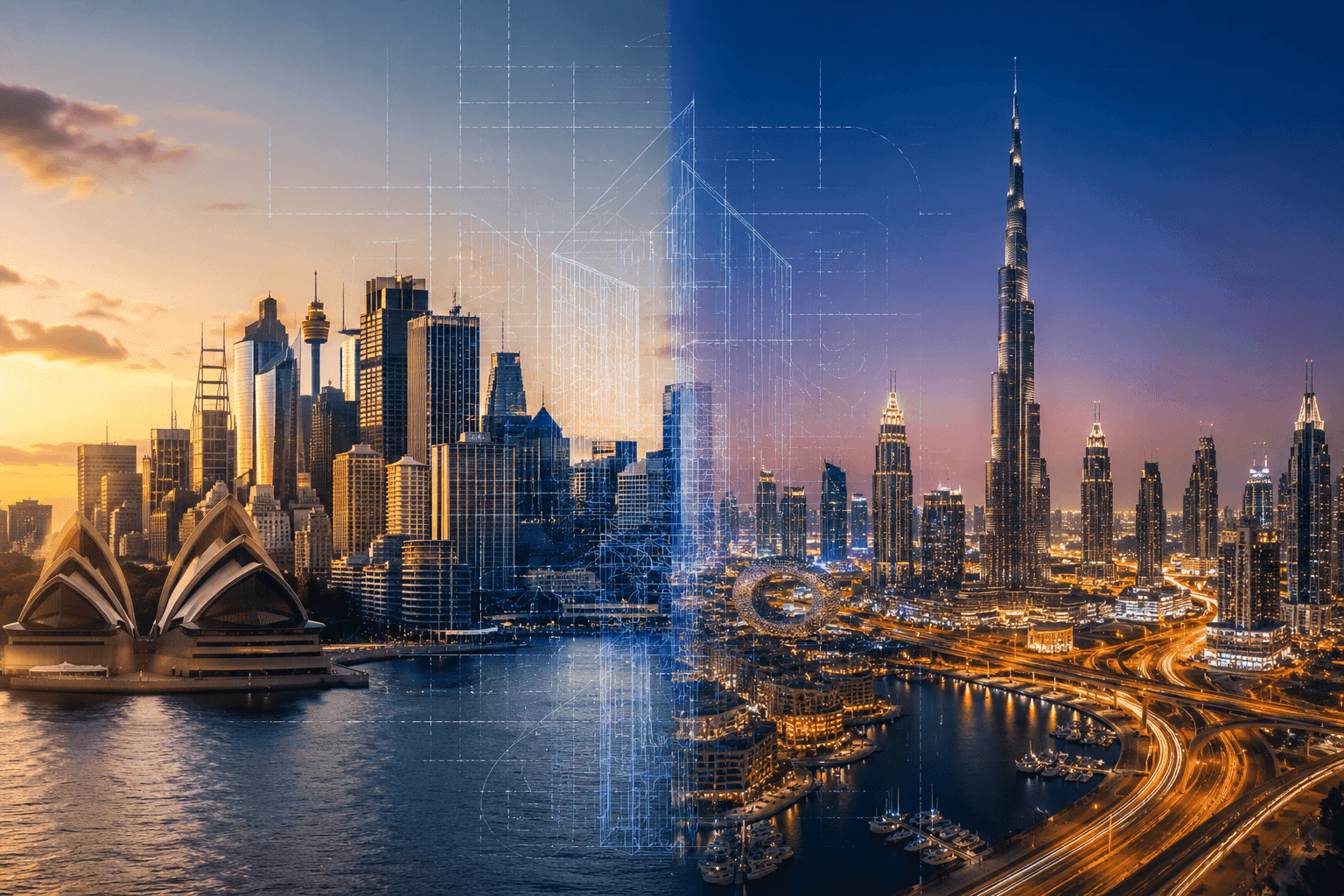
The Gulf Isn't Pausing. It's Pivoting. Here's What That Means for Australia.
Regional instability has changed the conversation but it hasn't stopped the Australia-Gulf corridor. As Gulf nations pivot from growth to sovereignty, Australia's strengths in critical minerals, food security, clean energy, technology, and advanced capability are becoming more strategically relevant than ever. This article explores why the opportunity isn't shrinking, it's evolving.

It's the question people ask quietly, usually after the formal meeting ends, or in the corridor on the way out.
"What about the conflict? Is this still the right time?"
It's a fair question.
And it deserves a direct answer.
Yes, It Has Changed Things
Instability creates friction. Capital hesitates. Timelines stretch. Some projects slow. Some conversations pause.
That's real, and anyone telling you otherwise isn't operating in the region.
When the situation escalated, the immediate priority for anyone with people across the corridor was simple: make sure they were safe. With over 115,000 Australians living and working across the Gulf, that wasn't an abstract concern.
It was personal.
The feedback from the ground was consistent. The community held. Australians stayed. Gulf partners continued building. Australian diplomatic missions in Abu Dhabi, Dubai, Riyadh, and Doha provided stability and continuity. The relationships built over years proved more durable than the headlines suggested.
That matters.
Because it tells you something about the nature of this corridor that no trade statistic can.
But Instability Is Also a Forcing Function
History is consistent on this point.
Disruption exposes dependencies. It accelerates decisions that were already overdue. It pushes nations to build what they previously outsourced and secure what they previously assumed was guaranteed.
This is the shift now underway across the Gulf: from growth to sovereignty.
The region isn't retreating from ambition. It's redirecting it.
The priorities have sharpened.
Defence and industrial AI are being localised. Sovereign compute data centres, energy, and physical infrastructure is being treated as a national security asset, not just an economic one. Food security, water systems, energy resilience, and supply chain control have moved from policy documents to funded programmes with real urgency behind them.
The mega-projects haven't stopped.
NEOM, Red Sea Global, Diriyah, and the Al Maktoum Airport expansion are continuing.
But the framing around them has evolved.
It's less about spectacle and more about capability.
Less about attracting the world and more about building systems that don't depend on the world being stable.
The Framework Is Still Being Built and That's the Window
Here's something most people miss when they look at this corridor through a risk lens.
The Australia-UAE CEPA is in force. It's Australia's first free trade agreement in the Middle East, and it covers the sectors that matter most right now - renewable energy, critical minerals, food security, data centres, technology, and professional services. Bilateral trade between Australia and the UAE grew more than 35 per cent since signing.
That happened during a period of regional instability.
With Saudi Arabia and Qatar, the bilateral frameworks are still being shaped.
That's not a weakness.
It's a window.
The businesses and institutions that engage now, at the relationship-building stage rather than the contract-signing stage, will be the ones with first-mover position when the formal agreements follow. Saudi Arabia and Australia are already in active dialogue on trade cooperation. Qatar's engagement with Australian education, energy, and agritech sectors is deepening. The GCC-wide FTA with Australia paused since 2009 and now back as a priority - is the next chapter. The UK signed a full GCC FTA in May 2026. Australia need3s to move.
What Australia Produces Is What the Gulf Now Urgently Needs
This is the part most Australian businesses haven't fully absorbed yet.
Australia is not just a food and resources exporter. It is a producer of the exact capabilities the Gulf is now prioritising at a sovereign level.
Agricultural technology and food systems for a region with acute food security concerns.
Critical minerals - lithium, cobalt, rare earths essential for the energy transition and the defence supply chains being built across the Gulf.
Clean energy expertise - green hydrogen, solar, and wind as Gulf states accelerate domestic renewable programmes. Advanced manufacturing and defence-adjacent technology as localisation mandates grow. Biotech and medtech as healthcare sovereignty becomes a policy priority.
Water systems for one of the most water-stressed regions on the planet.
These aren't nice-to-haves in a diversifying economy. In a region focused on resilience, they are strategic assets and Australia is one of the few countries in the world that can credibly supply all of them. The corridor didn't break under pressure.
It became more relevant.
The Mindset Shift Required
If you approach this market with a 2019 mindset, you will struggle.
In 2019, the Gulf felt like a growth story. Deals moved on relationships and timing. The energy was expansive. Entry felt relatively straightforward for anyone with a credible offering.
Today, it's different.
The Gulf is in a capability-building phase. Governments are making deliberate choices about who they partner with and why. Localisation requirements are real. The question being asked across ministries, sovereign funds, and procurement committees isn't just, "What do you offer?"
It's:
"What do you build here, what do you leave behind, and how does this strengthen us?"
That's actually good news for Australia.
Because Australia's relationship with the Gulf is built on depth, not just transaction. The alumni networks, the diplomatic relationships, and the community of Australians embedded across the region create a starting position that newer entrants to the corridor don't have.
The question is whether Australian businesses and innovators are ready to show up at the level the moment requires.
Who Wins in This Environment
Not the ones waiting for stability before engaging.
Not the ones pitching generic market entry.
The ones who win are those who understand what this moment is accelerating and who arrive with something genuinely useful to the sovereignty and resilience agenda being built across the Gulf right now.
The corridor is structural.
The relationship is strategic.
The need is real and urgent.
The question isn't whether to engage.
It's whether you're positioned to engage at the right level.
Hatch Quarter operates across the Australia-Gulf corridor, connecting businesses, investors, and government bodies on both sides. If you want to understand where your opportunity sits and who to engage, start the conversation with us.
References
- Australian Government – DFAT. Australia-UAE CEPA overview
- Australian Government – DFAT. Australia-GCC FTA status
- GCC Business News. UAE and Australia explore trade, defence and economic cooperation (May 2026)
- Australian Strategic Policy Institute. From crisis partners to strategic partners: deepening Australia-UAE defence ties (June 2026)
- Australian Institute of International Affairs. Australia's Gulf Moment (September 2025)
- Wikipedia. GCC-UK Free Trade Agreement (signed May 2026)
- Australian Saudi Business Forum. Australia's A$30B Trade with GCC (March 2026)
- Gulf Research Centre. Saudi Arabia-Australia Relations: Strategic Convergence
- Australian Government - Smartraveller. Middle East travel advisories
- Australian Embassy UAE. Bilateral relationship and community support
- Hatch Quarter. Gateway to the Gulf: Success in a New Era - delivered with Global Victoria, September 2025